
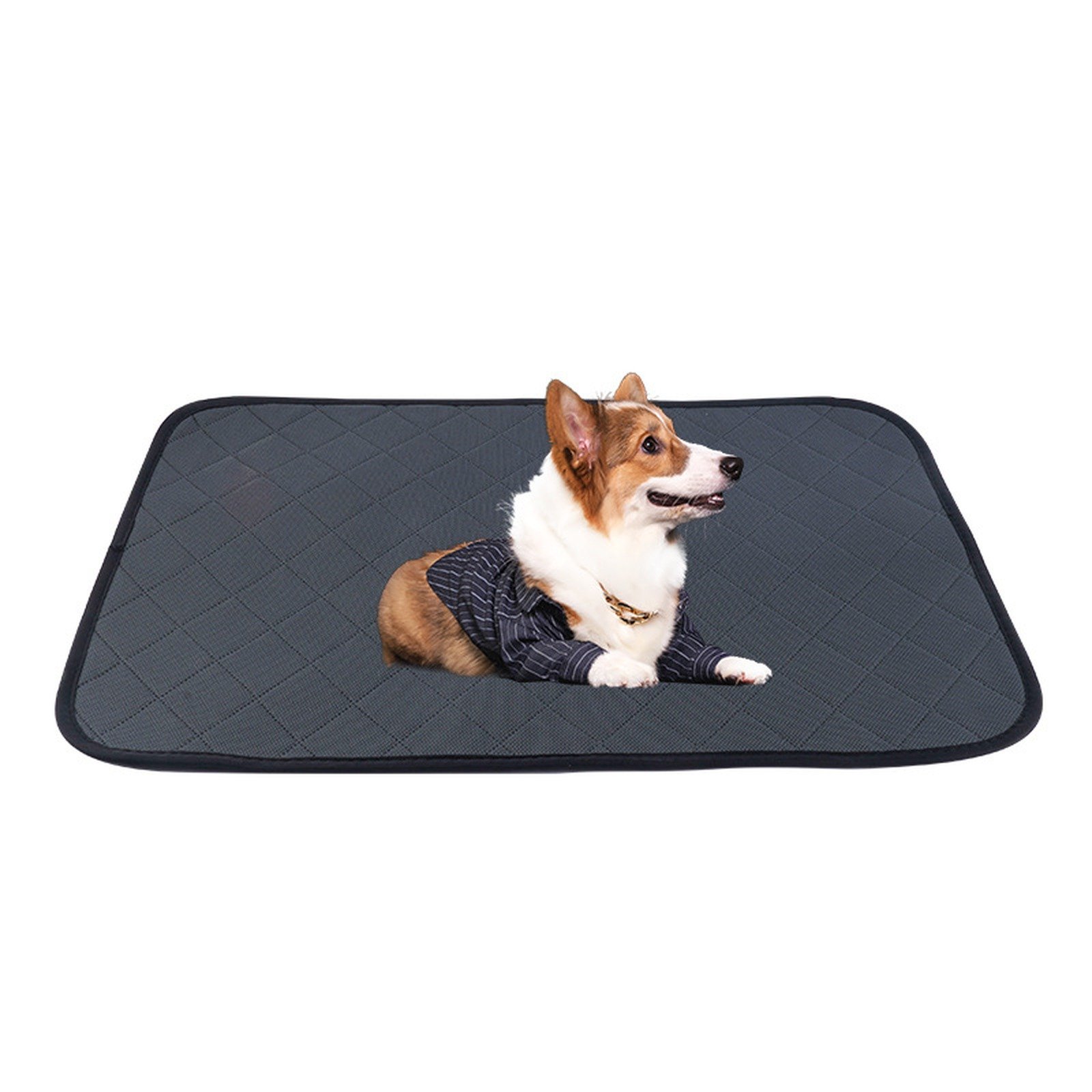
Most pad comparisons start with materials; buyers should start with order: a washable pad is a stack with a job to do in sequence — accept liquid at the face, hold it in the core, block it at the backing, seal it at the edge. When a pad fails, the symptom names the interface that gave way, not the material that looks cheapest on the quote.
The short answer
Read the pad top to bottom as a directed stack. The face controls pass-through and surface feel; the core holds liquid under pressure; the backing blocks it; the binding seals the perimeter. Confirm the layer order, materials and how they are joined on your spec sheet — a change at one layer moves the job onto its neighbours. Samples are US$25–40 per model and take 5 days.
The stack is directional, not a list of parts
Liquid meets the face first. The face has to pass it quickly enough that the surface does not stay wet, but tightly enough that the core is not loaded in one spot. The core takes the volume and holds it when the dog lies down; a core that absorbs but releases under pressure produces a wet surface even though the pad is doing half its job. The backing is the stop that keeps the floor dry, and the binding closes the path at the perimeter, where liquid can travel sideways along the seam.
The face sets the rate at which the core fills. The core sets how flat the pad stays under load. The backing’s stiffness changes how the binding behaves at the edge. A stack is a chain of hand-offs.
Where each failure actually starts
| Symptom | First place to look | What is usually happening |
|---|---|---|
| Surface stays damp after the dog stands | Face and core interface | The face passes liquid too slowly, or the core releases it under pressure. |
| Floor wet under a pad that looks dry | Backing and seam | A breach in the backing, stitch holes through it, or liquid wicking past the edge. |
| Damp ring on carpet at the perimeter | Binding and edge | The binding carries liquid, or the backing does not reach into the seam. |
| Core bunches or pad sags after washing | Attachment between layers | Quilting or lamination is not matched to the wash, so the core migrates inside the pad. |
What changing one layer does to the others
A denser face slows pass-through, so the surface stays wet longer and the centre of the core does less work. A lighter face passes liquid faster, loading the core locally and pushing moisture toward the backing before the core has taken it up. Change the face and you change the core’s working conditions.
The core carries the obvious trade-off. More capacity usually means more material, slower drying and more weight in the wash; less capacity dries faster but rewets sooner. A heavier backing keeps the floor drier but stiffens the pad, adds noise and stresses the binding at every fold. A wider or taped binding may close the seam while adding a wicking path or bulk at the corners.
A substitution does not remove a failure. It relocates it. Decide which failure you can live with before you approve the change, because the customer will meet the relocated version.
Interfaces fail before materials do
Ask how the layers are joined, not only what they are. A laminated stack can delaminate; a quilted stack can shift along the stitch lines; a loose core can bunch in the wash. Stitch holes through a coated backing are a path for water, and a binding sewn through every layer can wick liquid to the edge. These are interface decisions, and they rarely appear on a quote that lists materials only.
At sample stage, cut one pad open along a corner — not the one you will install — and check the layer order and attachment. Then wash the intact sample and repeat the checks, as the sample evaluation checklist sets out. If the core moved or the backing separated, the interface is the problem, even when every named material is correct.
Writing the stack onto the spec sheet
- Top-to-bottom order, each layer named by material and construction; weight and thickness confirmed on your spec sheet, with a retained sample from the approved lot.
- The attachment method at each interface — laminated, quilted, loose or adhesive — plus the seam type.
- The wash protocol the pad claims, and which layers were checked after it.
- The failure each layer is responsible for, so inspection has a reference rather than an impression.
The order matters as much as the names: four good materials in the wrong sequence can pass every material check and still leak at the edge.
Questions we get asked
The floor is wet but the top feels dry — which layer is at fault?
Start at the backing and the edge, not the core. A dry surface with a wet floor points to a breach in the backing, a stitch line, or wicking along the binding. Test the pad upside down before changing the core.
Can I change the core without resampling the whole pad?
No. The face controls the fill rate, the backing controls how the pad sits, and the binding has to close a different thickness. A core change is a stack change and needs a new sample.
Does a thicker pad always hold more?
Not by itself. Capacity comes from the core’s material and construction, and a thicker pad can dry more slowly without holding more. Compare a fixed pour, a press with a dry cloth and drying time.
What should I ask for if I cannot see the layers?
Ask for the layer order in writing, the attachment method at each interface, the wash protocol and a sample you can cut open. Without those, the spec sheet cannot be inspected.
If you are specifying a washable pad, send the failure you are buying against and the market it sells into. We will say which interface we would test first and what to change without moving the problem elsewhere. Start from the washable leak-guard dog pad construction, compare materials in washable dog pad materials compared, or reach the contact page — one business day for a reply.