
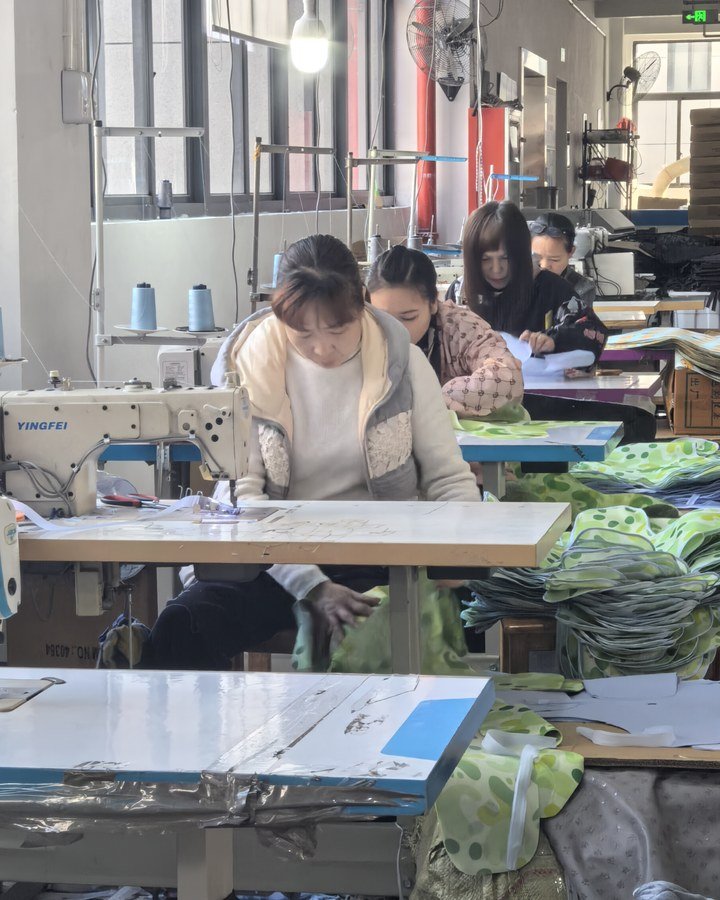
The question arrives early in most first conversations: are you the factory, and should we be talking to a factory directly? Both routes place good orders. What differs is who owns the specification, who answers when something is wrong, and what you pay for the layer in between.
The short answer
Factory-direct means you contract with the workshop that runs the machines: fewer layers, usually one product family, and you carry the specification, quality standard and export paperwork yourself. A sourcing partner means one contract with a team that holds your specification and sample standard, and places production with the workshop that makes it best. Decide with three questions: who owns the spec, who answers when a batch is wrong, and how many suppliers you want to manage.
What factory-direct actually asks of you
- You own the specification — not just writing it, but translating what your market needs into lines a production line can run, and defending those lines when a substitute material appears.
- You own the quality standard. The approved sample is yours to hold, the inspection reference is yours to name, and the conversation about a mismatch happens between you and the workshop.
- You own the paperwork: commercial invoice, packing list, any testing your buyer or marketplace asks for — or you pay a forwarder to own it.
- You work inside one product family. A workshop that sews mats rarely produces ramps or car seat covers, so a range that spans several product types becomes several relationships, each with its own terms and minimums.
What changes when you work through a partner
| Dimension | Factory-direct | Sourcing or manufacturing partner |
|---|---|---|
| Contract | With the workshop that runs the machines | With one team that owns the order end to end |
| Specification | You write it and defend it against the line | Held and translated into a spec you approve |
| Product range | Whatever that workshop makes in quantity | Several families, placed with the workshop that runs each best |
| When something goes wrong | You negotiate directly with the line | The partner raises it with the workshop and reports back with evidence |
| Export paperwork | You or your forwarder organise each document | Quotation, proforma invoice and export documents prepared for you |
| Access | Your own relationship, your own audit | Visits and video walkthroughs arranged on request |
Where the price difference really sits
The visible difference is the unit price: a partner quotes a figure that includes their work, and the workshop’s own price is naturally lower. The invisible difference is the cost of doing that work yourself — the first specification that comes back wrong, the trip for an audit, the batch reworked because a tolerance was never written down, the freight booked late because a document was missing.
Direct pays off when you have volume, an experienced sourcing team and a product family you understand deeply. A partner pays off when you are launching, running several product types, or building a brand rather than running a supply chain. The mistake in both directions is the same: choosing the model that looks cheaper per unit and ignoring the hours and failure risk attached to it.
Signals that tell you which model you are in
- Who signs the sample? If the piece you approve is issued by the party you contract with, the specification is being held for you. If you write it alone, you are running the order.
- What happens at step four? Ask whether you can still say no after seeing the sample and before production starts.
- Which documents arrive unasked? Quotation with Incoterms stated, proforma invoice, inspection photographs — these show how much of the export process sits with them.
- Who is named on the contract? A named entity you can check beats a generic trade name, in either model.
How we work, so you can judge it plainly
Pawbotics is a private label pet products manufacturer. We are not the workshop: we hold the specification, own the sample approval and the inspection standard, prepare your quotation, proforma invoice and export documents, and keep one contact for your questions. Production runs with specialist pet-product partner factories we work with every week. The partner’s floor is 4,000 m², its records show 100% on-time delivery and a 64% repeat-buyer rate, and it has been making pet products since 2018. Those figures are confirmed in writing with your quotation so you can check them rather than take them on trust.
Visits are welcome and video walkthroughs can be arranged — preparing for a factory visit covers what to look at on the floor, and the questions to ask any pet product supplier apply to us exactly as they apply to a workshop.
Questions we get asked
Is buying direct always cheaper?
Cheaper per unit, usually. Cheaper in total, only at a scale where the work you take on is covered by your own team. For a first range, specification, inspection, documentation and rework risk are real costs, and they tend to exceed the margin saved.
Do I pay more when I work through a partner?
You pay one price that includes the layer, so the comparison works only if you ask what is inside it: specification work, sampling, inspection photographs, export documents, and who is accountable if the bulk misses the sample.
Can I visit the factory if I work with you?
Yes. Buyer visits to the production partner can be arranged, and a video walkthrough is available when travel does not make sense. Ask for a date against your production window so the visit lands after sample approval and before the bulk run.
Can I move to a direct relationship later?
Your specification, artwork and brand assets are yours, and we name the production partner on the quotation rather than hiding it. If your volume grows to the point where direct makes sense, say so and plan the handover openly.
If you are deciding between the two routes, tell us the product, the quantity and who will run the order on your side — we will say honestly whether a partner structure or a direct one fits better. The about us page sets out who does what, and the contact page reaches us directly: one business day for a reply.