
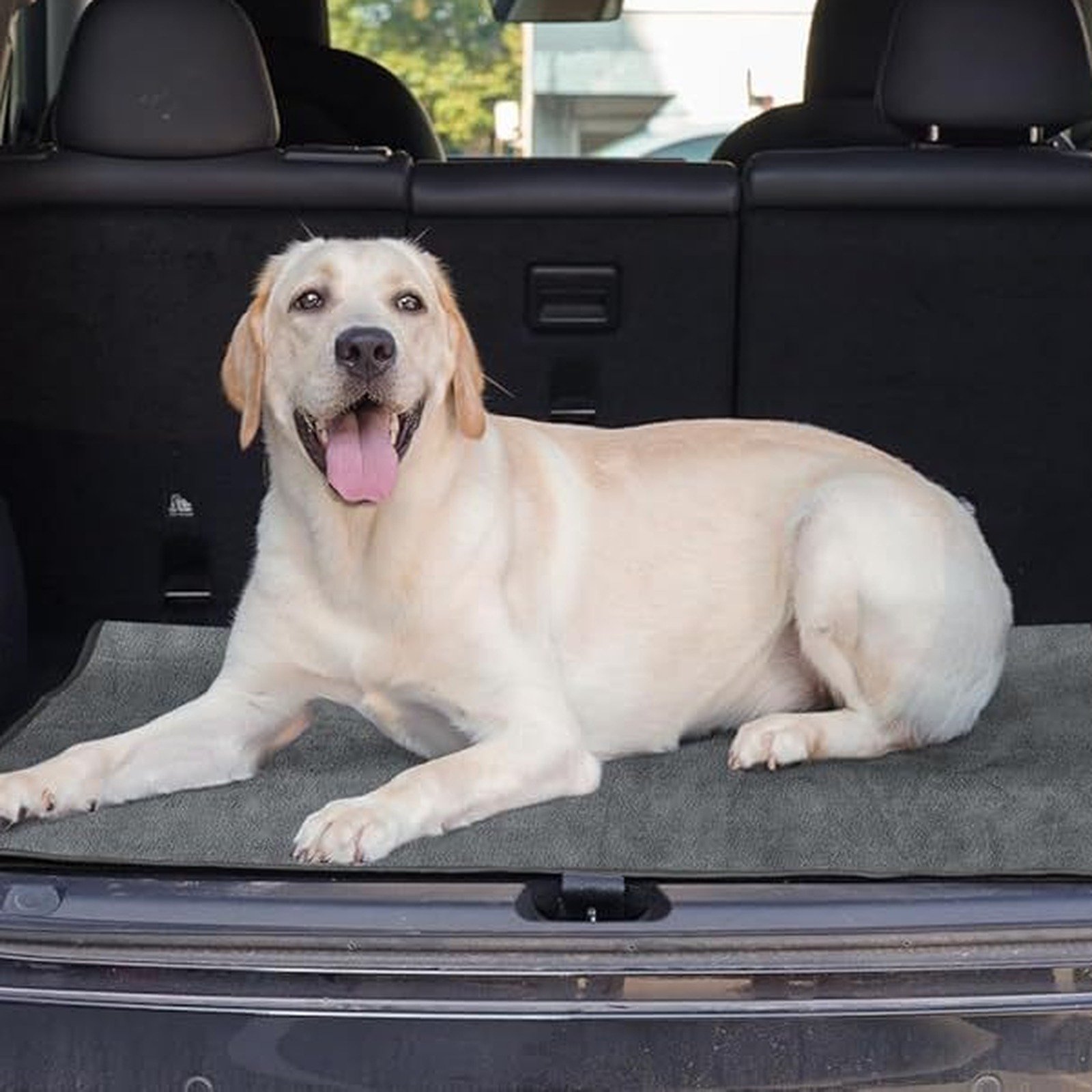
Buyers ask how a self-warming mat works for one reason: the mechanism decides the compliance load. Take the electricity out of a warmth product and an entire chain of certification, shipping documentation and recall exposure goes with it. That is also why the same mechanism sets a limit — it only helps while the dog is lying on it. Both halves matter when you plan the SKU.
The short answer
A self-warming mat has no heat source. It uses a reflective inner layer to send the dog’s own body heat back up through the mat instead of letting it drain into the floor. No plug, no battery, no heating element — so no electrical certification chain and nothing to explain at the border. The trade-off is honest: it warms only where the dog is already lying, so it is a comfort product, not a heat source. From 200 pcs per model, samples US$25–40 in 5 days.
What “self-warming” means in a specification
Construction, in plain terms: a soft face fabric on top, the reflective layer in the middle, and a backing underneath. The dog’s body heat reaches the mat, is reflected back rather than conducted away, and the surface under the dog stays warmer than a plain mat on the same cold floor.
The important consequence for your listing copy is that nothing is generated. There is no warming-up time, no element to reach a temperature, and no switch. The product is doing the same job whether the dog lies down for a minute or all afternoon — which is why it suits outdoor dogs, cars and floors, and why the wording on the packaging should describe retention, not heating.
Self-warming versus electric: the buyer’s comparison
| Question | Self-warming mat | Electric or battery mat |
|---|---|---|
| Where the heat comes from | The dog’s own body heat, reflected back through an inner layer | A powered element or a battery pack |
| Certification load | No electrical certification chain — the product is a textile | Electrical safety certification and market-specific rules apply |
| Shipping and travel | Nothing to declare beyond the textile goods themselves | Battery versions bring transport documentation for the cells |
| Care and returns | Care wording on the label; no cord or connector to fail | More parts to go wrong, and more instructions to write |
| Best-fit use | Everyday resting, travel, unheated floors, gifting | Cases where heat must be added rather than retained |
Read that table as a list of decisions rather than a verdict. The certification line alone changes the cost, the timeline and the amount of documentation your buyers will ask for — and it is the reason cordless warmth is the easy SKU to add to a range first.
When an electric mat is the better answer
If the customer’s problem is a dog that cannot hold its own warmth — very old, thin-coated, recovering from surgery or unwell — retention will not solve it, because there is little heat to retain. The same applies if the product has to warm an empty bed before the dog arrives. Those are electric-mat purchases, and they come with the certification, labelling and instruction work that goes with powered products. Knowing where the limit is protects you from a return wave, and it is worth saying plainly on the product page.
What to decide before you order the SKU
- Construction. How it warms is confirmed on your spec sheet — the reflective layer, and how the layers are assembled.
- Fabric and size range. Travel and floor sizes are standard, with custom sizes cut to order; face fabric, GSM and backing are specified per model.
- Colour. A neutral base as standard, or Pantone-matched to your brand palette.
- Labelling. Printed label, band or hangtag — your artwork on the label, hangtag and retail box.
- Packing. Rolled or folded as a single unit, with polybag, retail box and barcode options. Rolled versus folded changes carton count and freight, so settle it with the quotation in hand.
Every row is confirmed in writing before production. The reasons to keep the spec sheet current are set out in how to read a pet product spec sheet, and the same document becomes your inspection reference once you approve a sample.
Why the window, not the product, decides the order
Warmth purchases cluster in the Q4 window, so the thing that decides whether you catch it is timing rather than range width. Samples take 5 days, the production date is stated on your quotation, and freight takes its own time on top. Work back from your in-market date, not forward from your order date — the Q4 stocking guide walks through that math. One model at a modest quantity beats a full range ordered late.
Questions we get asked
Does it need electricity or a battery?
No. Self-warming works from the dog’s own body heat reflected back through the inner layer — no plug, no battery and no electrical certification chain. The mat is a textile product as far as shipping and documentation go.
How warm does it get?
There is no temperature to publish, because nothing in the mat generates heat — it retains what the dog produces. On a cold floor that is a noticeable difference; for an animal that cannot hold its own warmth, it is not a substitute for a powered mat.
Is it machine washable?
Care is a specification, not a slogan. What the face, the reflective layer and the backing will tolerate is confirmed on your spec sheet, and the care wording your market requires goes on the label. Ask for both in writing before you print packaging.
What is the minimum order, and can I sample a custom size?
MOQ is from 200 pieces per model, with custom sizes and fabrics available from that quantity. Send the dimensions and we will quote the sample — US$25–40 per model, credited back against your first order, prepared in 5 days.
Tell us your market, your channel and your target in-market date, and we will say which size and construction to start with, plus what the sample and production timeline looks like against your date. Start with the self-warming travel mat specification, or send the question through the contact page — one business day for a reply.