
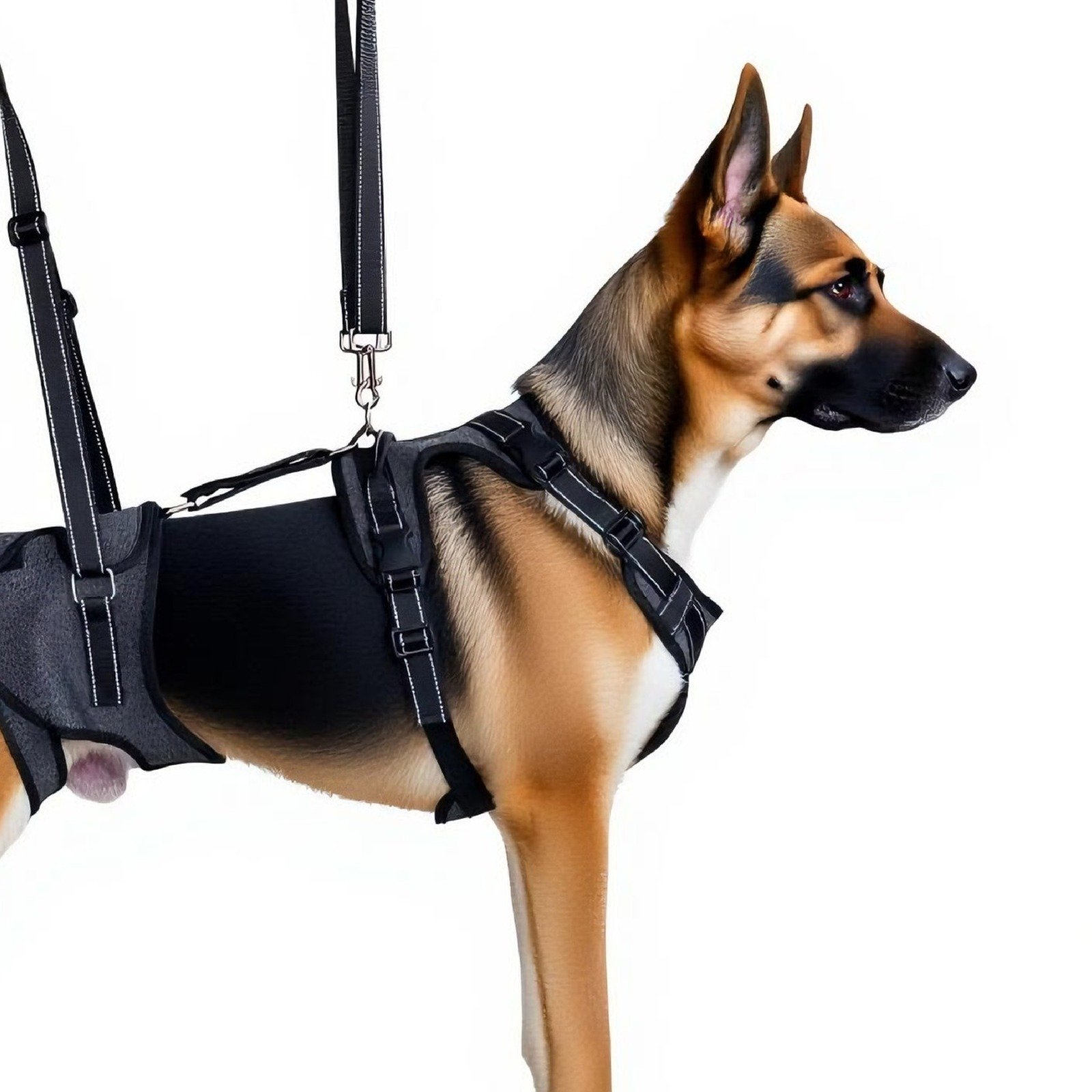
A harness spec sheet can carry three different weights and one word — “padded” — and still leave the buyer unable to answer the only question that matters: will this hold my customer’s dog? The numbers are not interchangeable, and padding is not a feature until its placement and density are written down.
The short answer
Read three numbers separately: the dog weight range that sets sizing, the rated load of the finished harness assembly, and the product weight that affects comfort and freight. Then read padding as placement, density and coverage, not a yes or no. Ask which component each rating applies to and how it was tested — a number without a method is not a rating. Trial quantities are on request; samples are US$25–40 in 5 days.
Three weights, three different questions
The first weight is the dog’s. It decides which size a customer selects and belongs on the size chart, not the strength claim. The second is the rated load of the finished harness — what the assembly is designed to support or lift. The third is the product’s own weight, which affects how it feels on the dog, how it packs and what freight costs. A catalogue that prints one “weight” without saying which one is asking you to guess.
| Number on the sheet | What it describes | What it does not tell you |
|---|---|---|
| Dog weight range | Which size to sell to a customer | The strength of the webbing, buckles or stitching |
| Rated load | What the finished assembly is designed to support or lift | Whether the dog will be comfortable or easy to fit |
| Product weight | How heavy the harness is to wear, pack and ship | Any strength claim at all |
What a weight rating has to name
A rating is only usable if it names the component and the method. Webbing may carry a tensile figure; buckles and D-rings may carry their own; the finished harness is a sewn assembly, and its limit is set by the weakest connection and the stitch pattern, not the strongest component. Ask for the rating of the assembly, the test method and whether a safety factor is included. A number for the webbing alone is a material claim, not a harness rating.
Then ask whether the rating carries across sizes. A larger size may use wider webbing and heavier hardware; a smaller size may use lighter components. One rating for the whole range is a warning sign. The spec sheet guide makes the same point: if a line cannot be checked, it is a description.
Padding: placement, density and coverage
Padding is where the product is judged, because the lift happens through a narrow area. Placement matters first: padding under the chest and behind the front legs does a different job from padding along the back, and the handle pulls against a specific panel. Ask for a dimensioned drawing or a marked-up sample, not “padded chest”.
Density and thickness decide whether the padding survives the lift. Soft foam feels good in the hand but can compress under load; denser foam holds shape but may feel stiff. Closed-cell and open-cell foams behave differently with water and odour. Coverage matters too: a pad that stops short of the seam concentrates pressure at its edge. Each is confirmed on your spec sheet — if it is not written down, the sample is the only specification.
The load path runs through the stitching
Follow the handle: webbing, bartacks, the panel it is sewn to, the adjusters and the buckles. Each connection is a possible weak point, and sewing through webbing reduces its strength depending on the stitch pattern and the number of passes. Ask how the handle is reinforced, how the seams are finished, and whether the hardware is rated for the load the assembly claims. A harness can pass a webbing test and fail at a bartack.
Padding and structure also interact. A padded panel that is not reinforced can stretch; a reinforced panel with no padding can dig in. Specify the pair together and test the sample as a pair.
What to ask before you approve the sample
- Which weight range sets the size, and where does each size start and end?
- What is the rated load of the finished harness, by what method, and with what safety factor?
- Where is the padding placed, what is it made of, and what are its density and thickness?
- Does the handle attachment change between sizes, and does the rating follow?
- What care instruction is the padding tested against?
Put the answers on the sheet before the sample is made. A sample approved against a verbal explanation is a sample approved against nothing.
Questions we get asked
Is the weight rating the dog’s weight?
No. The dog’s weight range is a sizing tool; the rated load is a claim about the finished assembly. A harness sized for a heavy dog is not automatically rated to lift that weight, and a rating is meaningless unless it names the component and the test.
What padding should I specify for a lift-assist harness?
Padding where the lift happens, at a density and coverage confirmed on your spec sheet. Ask for placement on a drawing and test the sample with a load. “Padded” on its own is a description, not a specification.
Does a higher load rating mean a better harness?
Not necessarily. A higher rating can add weight, stiffness and cost without improving fit or comfort. Match it to the dogs you sell for, then test the assembly rather than only the webbing.
Can one rating cover every size in the range?
Only if the construction is identical across sizes. Webbing width, hardware and stitching often change with size, so each size needs its own confirmed rating. Ask for the rating per size before the range goes on the sheet.
Send the dog weight range, the lift use and the size break-out, and we will say which ratings and padding lines belong on the sheet before a sample is made. Start from the senior dog lift-assist harness, read how to read a pet product spec sheet, or reach us through the contact page — one business day for a reply.