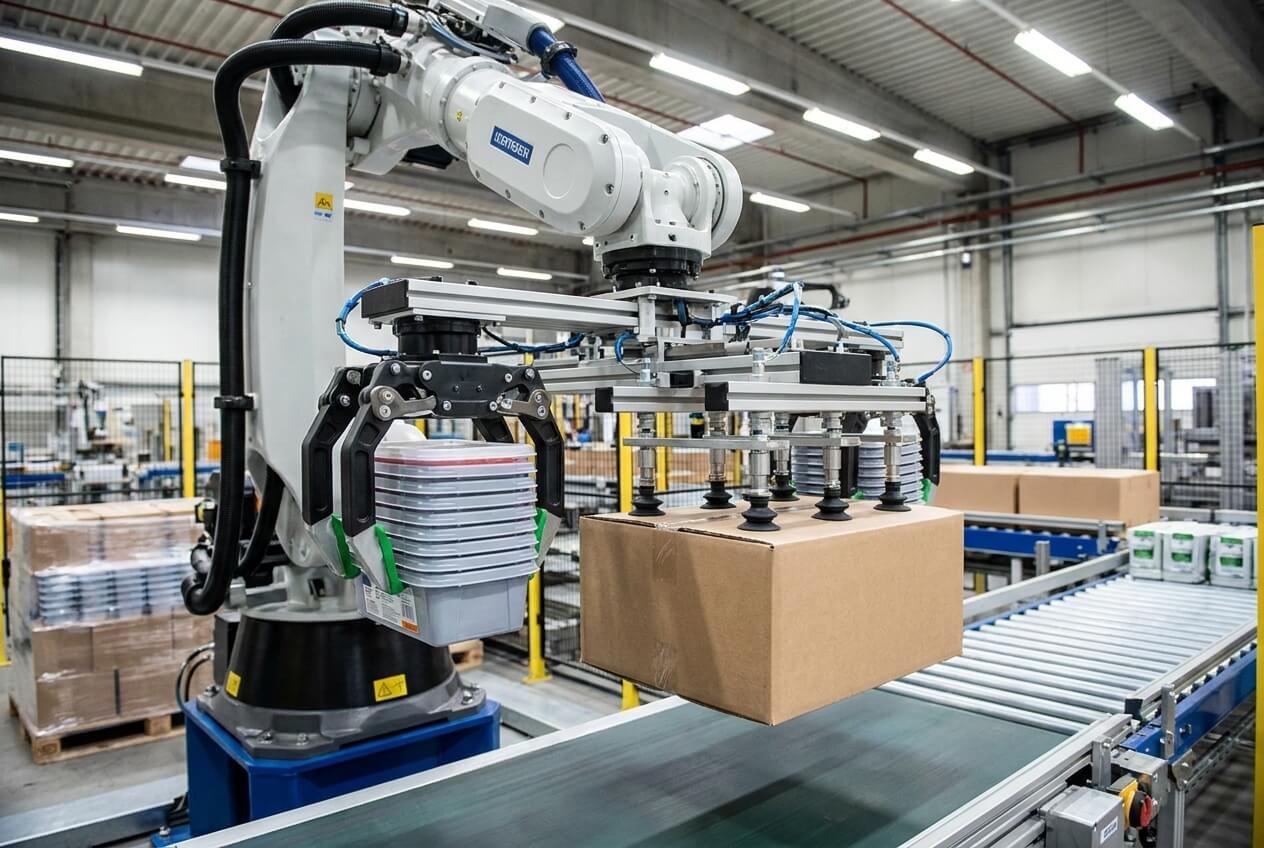
A robotic gripper is the end-of-arm tool that allows a robot to hold, move, orient, or release objects with controlled force and precision. In industrial automation, it acts like the robot’s hand, enabling pick-and-place, assembly, packaging, machine tending, inspection, and material handling across factories, warehouses, laboratories, and high-mix production lines.
Video Guide: This overview explains robot gripper classification, design considerations, and selection principles for industrial automation.
What is Robotic Gripper?
A Robotic Gripper is an end-effector mounted to a robot arm or automation system to grasp, hold, manipulate, and release parts. It can use fingers, jaws, suction, magnets, or soft materials depending on the object shape, surface, weight, fragility, and production environment.
Video Guide: This general introduction shows how robot grippers are used as practical end-of-arm tools.
Core Definition and Role
A Robotic Gripper converts robot motion into useful object interaction. While the robot arm provides reach, speed, and positioning, the gripper provides contact, retention, stability, and release control. Without the right gripper, even a highly advanced robot may fail to handle real-world parts reliably.
Common gripper roles include:
- Picking parts from trays, bins, conveyors, or fixtures
- Holding components during assembly or inspection
- Transferring products between machines
- Orienting items before packaging or processing
- Handling delicate, irregular, slippery, or heavy objects
- Supporting collaborative robot applications where safety matters
A practical gripper selection usually depends on the part geometry, payload, cycle time, gripping force, surface condition, and available utilities such as compressed air, electricity, or vacuum.
Pawbotics Pro Tip: I always recommend defining the part first, not the robot. If you know the object’s weight, material, tolerance, and pickup orientation, choosing the right gripper becomes much easier and far less risky.
How Does Robotic Gripper Work?
A Robotic Gripper works by generating a holding force through mechanical, pneumatic, electric, hydraulic, magnetic, or vacuum-based actuation. The robot positions the gripper near the object, the gripper engages the part, sensors confirm grip status, and the robot moves the item to its target location.
Video Guide: This mechanical design demonstration helps explain how a robotic gripper converts actuation into gripping motion.
Working Principle
Most grippers follow a simple sequence: approach, align, grip, verify, move, release, and reset. The actuation method determines how the gripping force is created, while the mechanical design determines how that force contacts the part.
A typical gripping cycle includes:
- Approach: The robot moves the gripper toward the object using programmed coordinates or sensor guidance.
- Alignment: The gripper positions its fingers, suction cups, or contact surfaces around the target.
- Engagement: The actuator closes fingers, activates vacuum, energizes a magnet, or inflates a soft structure.
- Grip confirmation: Sensors may verify position, force, vacuum level, or part presence.
- Transfer: The robot moves the object while maintaining stable holding force.
- Release: The gripper opens, vents vacuum, de-energizes, or relaxes pressure.
- Return: The robot resets for the next cycle.
Advanced systems may also include force feedback, compliance control, vision guidance, collision detection, and adaptive gripping profiles for variable products.
Pawbotics Pro Tip: I prefer grippers with grip confirmation sensors whenever downtime is expensive. A simple part-present or force signal can prevent dropped parts, machine crashes, and silent production defects.
What are the 5 types of robots and explain each type?
The five common industrial robot types are articulated, SCARA, Cartesian, delta, and collaborative robots. Each can use a Robotic Gripper, but their structure, speed, reach, payload, and application fit differ, which affects griprobotic gripper, actuation method, and control requirements.
Video Guide: This video discusses industrial robot gripper types and helps connect gripper choice with robot applications.
Major Robot Categories Used with Grippers
Based on our internal data and market analysis, here is the breakdown:
| Robot Type | Description | Typical Gripper Use | Best-Fit Applications |
|---|---|---|---|
| Articulated robot | Multi-joint robot arm with high flexibility and reach | Mechanical, pneumatic, vacuum, magnetic, or servo grippers | Welding, assembly, palletizing, machine tending |
| SCARA robot | Fast horizontal-motion robot with selective compliance | Small pneumatic or electric grippers | Electronics assembly, light pick-and-place, packaging |
| Cartesian robot | Linear-axis robot moving in X, Y, and Z directions | Vacuum cups, parallel grippers, custom tooling | CNC loading, dispensing, gantry handling |
| Delta robot | High-speed parallel-link robot mounted above a workspace | Lightweight vacuum or small mechanical grippers | Food sorting, packaging, conveyor picking |
| Collaborative robot | Robot designed to work near people with safety features | Electric, adaptive, soft, or force-limited grippers | Flexible automation, lab work, small-batch production |
The best robot type depends on workspace layout, required speed, payload, precision, safety requirements, and whether the task involves rigid, delicate, or irregular products. The gripper must be matched not only to the part, but also to the robot’s wrist payload and moment limits.
Pawbotics Pro Tip: I always check the combined weight of the gripper, brackets, sensors, cables, and payload. Many projects fail because the selected robot can lift the part, but not the full end-of-arm tooling package safely at speed.
What is the function of a gripper in a robot?
The function of a gripper in a robot is to create controlled physical interaction with an object. It enables the robot to pick, hold, orient, stabilize, transfer, assemble, inspect, or release items accurately, turning programmed robot motion into useful material handling and production work.
Video Guide: This video frames the gripper as the “hand” of robotics and explains its practical role in manipulation.
Functional Capabilities in Automation
A gripper is responsible for secure and repeatable contact. Its design affects accuracy, cycle time, product quality, and safety. In many applications, the gripper is more important than the robot arm because it directly touches the product.
Key functions include:
- Grasping: Holding an object using force, vacuum, magnetism, or material conformity
- Positioning: Keeping the object aligned during motion or assembly
- Stabilizing: Preventing slip, rotation, vibration, or deformation
- Transferring: Moving items between conveyors, fixtures, machines, or stations
- Orienting: Rotating or presenting parts in the correct direction
- Protecting: Handling fragile or finished surfaces without damage
- Verifying: Confirming part presence, grip success, or force level through sensors
For example, a vacuum gripper may lift cardboard boxes rapidly, while a servo-electric gripper may gently hold precision-machined components with measured force.
Pawbotics Pro Tip: I treat the gripper as a process tool, not just an accessory. If the gripper damages parts, slips, or lacks feedback, the whole automation cell becomes unreliable no matter how good the robot is.
How many types of grippers are there?
There are many types of grippers, but the main industrial categories include mechanical, pneumatic, electric, hydraulic, vacuum, magnetic, soft, and adhesive grippers. Each type solves a different handling problem based on object weight, surface, shape, fragility, speed, cleanliness, and control needs.
Video Guide: This video shows different robot gripper mechanisms and how they vary by design.
Common Gripper Types
Based on our internal data and market analysis, here is the breakdown:
| Gripper Type | How It Holds the Object | Strengths | Limitations |
|---|---|---|---|
| Mechanical gripper | Uses fingers or jaws to clamp parts | Versatile, strong, precise | May need custom fingers |
| Pneumatic gripper | Uses compressed air to open or close jaws | Fast, affordable, widely used | Less force control than servo-electric |
| Electric gripper | Uses motor-driven actuation | Programmable force and position | Higher upfront cost |
| Hydraulic gripper | Uses pressurized fluid for high force | Excellent for heavy loads | More complex maintenance |
| Vacuum gripper | Uses suction cups or vacuum pads | Great for flat boxes, sheets, panels | Needs suitable surface and seal |
| Magnetic gripper | Uses permanent or electric magnets | Strong for ferrous metals | Only works with magnetic materials |
| Soft gripper | Uses flexible materials to conform to objects | Gentle and adaptive | Lower force capacity |
| Adhesive gripper | Uses sticky or gecko-inspired surfaces | Useful for delicate surfaces | Surface conditionsupal can limit reliability |
In practice, “how many” gripper types exist depends on how narrowly they are classified. Many systems combine categories, such as a mechanical gripper with vacuum assistance or an electric gripper with soft fingertips.
Pawbotics Pro Tip: I recommend testing with real production parts before final purchase. CAD models rarely reveal surface dust, oil, burrs, packaging variation, or deformation that can change gripper performance dramatically.
Key Features & Comparison
The key features of a Robotic Gripper include payload capacity, gripping force, stroke, speed, repeatability, compliance, sensing, actuation type, environmental resistance, and ease of integration. Comparing these factors helps determine whether the gripper can meet production demands reliably and safely.
Video Guide: This selection-focused video explains how to choose robot grippers for different automation needs.
Feature-by-Feature Comparison
Based on our internal data and market analysis, here is the breakdown:
| Feature | Why It Matters | Best Option for High-Speed Lines | Best Option for Delicate Handling | Key Selection Question |
|---|---|---|---|---|
| Payload capacity | Determines maximum object weight | Pneumatic or vacuum gripper | Electric or soft gripper | Can it hold the part plus safety margin? |
| Grip force | Prevents slipping or dropping | Pneumatic or hydraulic | Servo-electric with force control | Can force be controlled without damage? |
| Stroke range | Defines jaw travel or contact range | Parallel pneumatic gripper | Adaptive electric gripper | Can it handle part variation? |
| Cycle speed | Impacts throughput | Pneumatic or vacuum | Electric with optimized profile | Will it meet takt time? |
| Repeatability | Affects placement accuracy | Electric or precision mechanical | Electric | Is position repeatability required? |
| Compliance | Allows tolerance to variation | Soft or adaptive gripper | Soft gripper | Are objects irregular or fragile? |
| Sensing | Confirms grip and part presence | Sensor-equipped pneumatic | Electric with feedback | Does the process need verification? |
| Integration | Reduces commissioning time | Standard industrial gripper | Plug-and-play electric gripper | Is it compatible with the robot controller? |
| Environment resistance | Supports harsh or clean conditions | Sealed pneumatic or hydraulic | Cleanroom electric or soft | Are dust, washdown, heat, or chemicals present? |
The best gripper is not always the strongest or most advanced option. It is the one that handles the target part consistently within the required cycle time, safety limits, and maintenance budget.
Pawbotics Pro Tip: I look for the simplest gripper that meets the real requirement. Over-engineered tooling increases cost, programming time, spare parts, and failure points without always improving production results.
Cost & Buying Factors
The cost of a Robotic Gripper depends on actuation type, payload, precision, sensors, custom fingers, control compatibility, environmental rating, and installation complexity. Basic pneumatic grippers are usually lower cost, while servo-electric, adaptive, soft, or custom-engineered systems require a higher investment.
Video Guide: This RoboDK Academy lesson provides practical context for gripper usage in robot programming and deployment.
Pricing Guide and Purchase Criteria
Based on our internal data and market analysis, here is the breakdown:
| Buying Factor | Impact on Cost | What to Evaluate |
|---|---|---|
| Actuation type | Medium to high | Pneumatic is economical; electric offers better control |
| Payload and force rating | Medium | Higher force usually increases size and cost |
| Custom fingers or tooling | High | Custom contact surfaces may be essential for reliability |
| Sensors and feedback | Medium | Part detection, force feedback, and position sensing add value |
| Controller compatibility | Medium | Plug-and-play support reduces integration time |
| Environmental protection | Medium to high | Washdown, cleanroom, dustproof, or high-temperature ratings cost more |
| Maintenance requirements | Long-term cost impact | Consider seals, air lines, wear parts, and calibration |
| Safety requirements | Medium | Collaborative applications may need force limiting and soft contact |
| Application testing | Low to medium | Testing reduces risk before full deployment |
A realistic budget should include the gripper, mounting plate, fingers, cables, air fittings, sensors, programming time, testing, spare parts, and operator training. For production-critical automation, the total cost of ownership matters more than the initial purchase price.
Pawbotics Pro Tip: I advise budgeting for application trials and spare fingertips from the start. A low-cost gripper that needs constant adjustment or damages product quickly becomes the most expensive option on the line.
Conclusion
A Robotic Gripper is one of the most important components in any robotic automation system because it directly controls how parts are handled. Choosing the right type improves reliability, speed, safety, product quality, and return on investment across industrial applications.
Video Guide: This short overview reinforces the variety of gripper styles used in robotics and automation.
Final Selection Guidance
A successful gripper decision starts with the object, not the robot. Define the part’s size, weight, surface, fragility, variation, orientation, and required cycle time. Then match those needs to the correct gripping method, actuation technology, sensor package, and mounting approach.
Use this checklist before selecting a gripper:
- Confirm the object’s maximum and minimum dimensions
- Measure real part weight and center of gravity
- Identify surface conditions such as oil, dust, holes, or texture
- Determine whether force control or soft contact is required
- Calculate robot wrist payload including tooling and cables
- Verify required cycle time and release accuracy
- Decide whether grip confirmation sensors are necessary
- Test with real production parts before full deployment
- Consider long-term maintenance and spare part availability
For businesses evaluating automation, Pawbotics can help assess application requirements, compare gripper technologies, and identify the most practical solution for reliable industrial performance.
Pawbotics Pro Tip: I always tell teams to prototype the grip before finalizing the cell layout. Once the part-handling method is proven, robot selection, programming, guarding, and production planning become much more predictable.